
Group News: Hawaiʻi Island Group, Maui, and Oʻahu
Hawaiʻi Island Group
Upcoming Outings
Sunday, January 4
Kīpukapuaulu Trail Hike (E/C/F)
Hawaiʻi Volcanoes National Park, Keauhou, Moku o Kāʻū
1.2 miles, elevation: 4000’, +/- 100’.
Let’s celebrate the new year with an easy interpretive hike through a lush Hawaiian forest and the bird-song-filled air of Kīpukapuaulu. Many refer to this area as “bird park.” We will also tour the nearby spectacular giant tree molds. Bring rain gear along with your day-hike essentials. ROD protocol, please. We will meet at the Kīpukapuaulu trailhead on Mauna Loa Rd. Register for the hike by calling Phyllis Chung at 808-767-3563.
The Electrotech Revolution is Unstoppable
By Stephen Holmes, HIG ExCom member & former US Department of Energy National Energy Champion
While Governor Green is out promoting LNG, he is missing the global shift happening right in front of us: the world is moving away from Petrotech and toward Electrotech. Coal, natural gas, oil, and biomass are being replaced by cheaper, cleaner alternatives like solar, wind, and battery storage. Across the United States, utilities recognize the economics: renewable energy and storage continue to drop in price, outcompeting fossil fuels. We are also seeing remarkable breakthroughs in financing models, as things like energy-as-a service, power purchase agreements, and energy saving performance contracts shift to support electrotech.
Here in Hawaiʻi, the Department of Transportation is working with a company called Sustainability Partners on a bold proposal to use third-party financing, with no upfront cost to taxpayers, to dramatically expand energy efficiency measures, solar and battery storage, EV charging stations, EV fleet conversions, and resilient microgrids. The savings generated by these improvements cover the costs, creating a self-financing system (think free money) that cuts energy use, boosts resilience, creates jobs, and strengthens the local economy. Energy Service Companies (ESCOs) guarantee the savings, handle monitoring and verification, and manage the entire project. It couldn’t be easier.
This isn’t a new concept, the City & County of Honolulu, Maui County, and several state agencies have been slowly doing similar projects for decades. Energy-as-a-Service goes far beyond just government entities and can include commercial and industrial clients as well. The exciting news is that price drops in solar and battery storage plus new offerings like heat pumps, LED lighting, energy management systems, and more efficient electrical transformers have exploded the market opportunities.
In recent years, I have volunteered to help nonprofit condo homeowners associations adopt solar PPAs—25-year contracts offering free solar and guaranteed savings compared to HELCO rates, with maintenance included. With insurance and maintenance costs rising, many HOAs are desperate for relief, and renewable energy gives them a real way to fight back.
Nationally, solar and wind are under political attack, but the industry is adapting through consolidation and new partnerships with investors. Ironically, attempts to weaken renewable energy will likely backfire—driving prices even lower and accelerating deployment, since renewables remain the fastest and most cost-effective way to meet growing electricity demand. Fossil fuels, nuclear, and geothermal simply can’t compete on cost or development timelines.
So, the good news is that innovation, financing, and lower cost will continue to drive large scale deployment of renewables. Roadblocks simply won’t work and we can continue to make progress while helping to protect the environment. We need to educate our elected officials and push them to bring our electric bills down and quit shipping our money out of Hawaiʻi. We have the tools today to make this happen.
University of the Nations - Kona Tears Open Historic Wounds of Colonization in Hawaiʻi
By Chuck Flaherty, Hawaiʻi Island Group Chair
On December 3, the state Land Use Commission (LUC) held a hearing to decide whether to accept the University of the Nations–Kona’s 2020 Master Plan Update Second Final Environmental Impact Statement (FEIS). The Hawaiʻi Island Group submitted written and oral testimony urging the Commission to reject the FEIS for several critical reasons.
First, the FEIS explicitly violates the Commission’s 2003 Findings of Fact, Conclusions of Law, and Decision and Order for a Land Use Boundary Amendment (“D&O”). The University removed all mention of the 27-acre Cultural Center required by the 2003 D&O—a center intended to introduce visitors and local families to the authentic story of Native Hawaiian culture and its complex relationship with the arrival of Christianity, its impacts on the monarchy, the people, and the Kona region. The Cultural Center was envisioned as a place of fun, education, creativity, and cross-generational learning, set within a thoughtfully designed cultural landscape.
By erasing these requirements, and all provisions related to the protection and perpetuation of Native Hawaiian (kanaka maoli) cultural rights, the FEIS repeats the harms of colonization and echoes the exclusionary practices of the “Jim Crow” era. It disregards longstanding cultural, historical, and constitutional protections for kānaka maoli, their traditional and customary practices, and their lāhui.
Beyond this, the FEIS ignores other essential conditions in the 2003 D&O, including requirements that the University:
Preserve and protect cultural access, including religious practice, gathering rights, and access to burial and archaeological sites.
Develop the Cultural Center with sensitivity to the host Native Hawaiian culture and provide educational opportunities for Hawaiʻi’s keiki.
Collaborate with UH Hilo’s College of Hawaiian Language to promote Hawaiian language learning and cultural authenticity.
In a 2022 report, the University signaled its intent to replace the Cultural Center and other commitments with dormitories and student-support facilities—an alarming departure from what the LUC originally approved.
In short, the FEIS ignores the Commission’s prior D&O, undermines constitutional protections under Article XII, Section 7, and violates Hawaiʻi Revised Statutes (including Chapter 343) and Hawaiʻi Administrative Rules.
Despite these significant concerns, the LUC accepted the FEIS and denied a cultural practitioner’s request for a contested case, claiming she lacked a “property interest.”
The next step is for the University of the Nations - Kona to submit a motion to amend the 2003 D&O. The Hawaiʻi Island Group will continue to follow this issue closely and provide updates as this process unfolds.
Hike Leaders Needed!
Do you love exploring the outdoors and sharing its beauty with others? The Sierra Club Hawaiʻi Island Group is looking for passionate individuals to join us as volunteer outings leaders!
Our outings leaders guide hikes and service projects that connect community members to the stunning landscapes of Hawaiʻi Island while fostering a deeper appreciation for mālama ʻāina. Whether you’re experienced in leading groups or simply eager to learn, we’ll provide the training and support you need to succeed.
Why become an outings leader?
Inspire others to cherish and protect Hawaiʻi’s unique ecosystems.
Enjoy opportunities to explore new trails and sites.
Build community with like-minded outdoor enthusiasts.
Together, we can make a difference—on the trail and for the planet. If you’re ready to step up and lead, we’d love to hear from you!
Email our outings chair, Diane Ware, at volcanogetaway@yahoo.com to learn more.
Let’s explore and protect Hawaiʻi together!
Maui Group
Historic 2017 Settlement with Community Groups has Reshaped Mākena Resort Project
By Lucienne de Naie, Maui Goup Chair
For nearly five decades, the Sierra Club Maui Group and our allies have worked to protect hundreds of acres of biologically and culturally significant lands in the south Maui area known as Mākena. Famous for its white-sand beaches, Mākena is an arid landscape that receives less than fifteen inches of rain annually and relies on water piped nearly 30 miles from the fertile valleys of Wailuku and Waihe‘e in central Maui (Nā Wai ʻEhā).
Since the late 1980s, 1,800 acres of rugged slopes above Mākena Bay and along the southern coastline have been targeted for development by various landowners—sparking strong community opposition. Many local families had already been displaced by earlier smaller luxury developments in this traditional fishing area. Residents raised concerns about scarce freshwater supplies being diverted to luxury housing instead of meeting the needs of Maui families. Others pointed to the project’s plans for an exclusive “members only” club that would restrict shoreline access and parking, as well as proposals for five-story condos that would block scenic coastal views and threaten native wiliwili forests and numerous Hawaiian archaeological sites.
Community Groups Challenge Mākena Project’s Shortcomings
The current investors, AREG AC MĀKENA PROPCO LLC and luxury developer Discovery Lands, proposed a 47-acre luxury resort in 2017 containing 158 residential units overlooking Mākena Bay, two private beach clubs, and 26,500 square feet of commercial space. The original plan also significantly reduced public parking at the popular Mākena Landing Beach Park—from about 42 spaces down to as few as 20. All of which was challenged by the Maui Group and allies.
The legal challenge also raised concerns that the development would block the sweeping coastal views from Mākena Alanui Road—a public roadway designated as a high-value scenic corridor—with buildings proposed at heights of roughly forty-five to fifty-four feet (four to five stories). The ultra-luxury development additionally sought to sidestep obligations to build workforce housing by purchasing credits, and it committed to preserving only a limited number of archaeological sites despite the cultural richness of the area. Most significantly, the 47-acre proposal failed to evaluate the cumulative impacts of the full 1,800-acre development, despite the landowner’s long-standing master plan. Rather than litigate these issues for years, the parties moved toward resolution and entered into a settlement agreement in July 2017.
Mākena Settlement Agreement Attempts to Reduce and Mitigate Project Impacts
The settlement reshaped the 47-acre Mākena Landing project in major ways. Most notably, it eliminated all multi-story buildings. It also gave community groups meaningful input in selecting archaeological consultants and reviewing site findings.
Extensive archaeological surveys and testing validated what the Sierra Club and allies had long argued: earlier surveys had missed numerous significant cultural features. The developer’s initial design would have destroyed many of these sites. Through a collaborative consultation process, additional ceremonial sites and some of the region’s earliest cultural deposits were discovered, along with a traditional burial area that had previously gone unrecognized.
As the network of archaeological features grew, so did the preserve areas—and the development footprint shrank. The unit count dropped from the original 158 to roughly 78 as reflected in 2023 plans, with further reductions anticipated as archaeological work nears completion.
The settlement also protected existing beach parking, expanded public shoreline access, established new public parking areas, and created multiple preserve areas with trail access across the larger 1,800 acres. Additional provisions included improved drainage measures, on-site affordable housing, opportunities for nearby residents using cesspools to connect to the private wastewater system, and a community benefit fund to support local projects.
Proposed April 2017 pre-settlement design for the Mākena 47-acre coastal development: 158 units, multiple high-rise buildings, and minimal archaeological site preservation. Click to enlarge.
July 2017 settlement map showing fewer multi-story buildings, a reduced unit count of 134, and expanded protection of archaeological sites. Click to enlarge.
2020 post-settlement map showing no multi-story buildings, 78 units, and nearly 10 acres of archaeological preserves (brown), buffered by open space (green). Click to enlarge.
New Mākena Environmental Impact Statement Issued for 1,000-Acre Development
In December 2025, seven and a half years after the settlement, ATC Mākena released a Draft Environmental Impact Statement (EIS) for its larger 1,000-acre proposed development area. This full EIS was required under the settlement, as the project’s only previous EIS dated back to 1974.
The recently released Draft EIS reduces the proposed unit count to 652. Under the 2017 settlement, 60 of these units must be truly affordable—priced at or below 100% of HUD median income—and must remain affordable in perpetuity. The agreement also directs that, to the extent allowed by law, these homes be offered first to qualified families with 19th-century ties to the Mākena area, helping families return to the area. The settlement further requires that at least half of any additional affordable units mandated by county law be built on site, which could amount to roughly 70 more homes. Unfortunately, under current county laws, those additional units would only be required to stay affordable for about ten years.
The Draft EIS acknowledges that potable water for the project will likely come from a private well system with desalination, rather than County supplies (except for the affordable units). It also references the parking, trail systems, and preserve areas required by the 2017 settlement.
The Draft EIS can be accessed here or in the State’s December 8, 2025 Environmental Notice here. Unfortunately, the Maui Planning Commission will review the Draft EIS and submit comments on Tuesday, December 9 at 9am, giving the public only a few days to review the multi-volume document.
To watch or testify via Microsoft Teams:
Link: https://tinyurl.com/3njyj268
Meeting ID: 285 792 787 762 8
Passcode: LH3CF6fN
Written comments are accepted until January 22, 2026 to planning@mauicounty.gov or at makenapermitting.com
Upcoming Outings
Saturday, December 13
Makena Shoreline Hike (C/E)
Makena, 4 miles
Moderate, pleasant walk on "fisherman's trail", road, sandy beaches, rocky beaches past tidepools to Keoneuli (Black Sand Beach). Beautiful views. Meet 8am in the public parking lot for Polo Beach, near the entrance. Almost entirely exposed, so bring sun protection. We'll stop to eat anything we have with us at Keoneuli. Limit 15.
Leader: Rob Weltman, robw@worldspot.com
Sign up
Saturday, December 13
Makawao Forest Trail Maintenance Day (S)
Upcountry, 4 miles
Join us from 10am-1pm for a rewarding day of trail maintenance in the beautiful Kahakapao Forest Reserve in Makawao! Gloves and tools will be provided with safety training. Bring sturdy, closed-toe boots, water bottle, and protective clothing. Trail maintenance plays a vital role in preserving our forest ecosystems. Join our Facebook Group "Kahakapao Krew" to get the latest updates!
Leader: Raina Myers, raina.myers@sierraclub.org
Sign up
Sunday December 14, 2025
Mā‘alaea Historical Walking Tour (C/E)
Wailuku Moku (Māʻalaea), 2.5 miles
Repeat of this popular tour where we learn about Māʻalaea's colorful past, spanning over 600 years, as we stroll through the modern day harbor and along Hauʻoli Street to Haycraft Park. Guided by Lucienne de Naie, author of the recently published book, "Māʻalaea: the Untold Story of Maui's Historic Crossroads" with commentary by other longtime Māʻalaea residents. Those who have copies of the Māʻalaea book are welcome to bring them to have them signed.
Leader: Lucienne de Naie, huelogrl@icloud.com
Sign up
Wednesday, December 17
Keālia Pond National Wildlife Refuge (C/E)
Māʻalaea, 1 miles
Come see a variety of waterfowl and shorebirds as well as a very impressive and beautiful Hawaiian native planting area, and hear an overview about the refuge. See this link for plants and birds we may encounter. Meet 9:00 am at the Keālia Pond NWR Visitor Center (turn into driveway at mile post 6 on Mokulele/Maui Veterans Highway). Bring binoculars, suitable closed toe shoes for mud, sun protection, and water bottle. Limit 20.
Leader: Rob Weltman, robw@worldspot.com
Sign up
Friday, December 19
Palauʻea Archaeological Hike
South Maui (Palauʻea), 2 miles
Palauʻea mauka preserve had hundreds of archaeological sites recorded in 2013 and many rare and unusual native plants. This outing will explore a small portion of this intricate web of Palauʻea native plants and cultural sites including ancient stepping stone trails, habitation sites and possible ceremonial sites with guest guide, archaeologist Dr. Jeanne Schaaf. The terrain can be rugged in spots, and we will bring small hand tools in case sites are too overgrown to see. Please register by December 17 if possible, so we can get names to the landowner in advance.
Leader: Lucienne de Naie, huelogrl@icloud.com and Jeanne Schaaf
Sign up
Sunday, December 28
Honolua Bay Snorkel and ʻŌhai Loop and Nakalele Blowhole Hikes (C/E)
West Maui, 3 miles
We will begin with a short access trail hike and snorkeling at Honolua Bay (mile marker 32 on highway 30). We will then drive to the small parking lot between mile markers 40 & 41 on the makai (ocean) side of the highway, where we will hike the 1.2-mile ʻŌhai Loop Trail and Overlook. We will make a final stop at Nakalele Blowhole between mile markers 38 & 39 before returning to Māʻalaea by about 1:00pm. Bring snorkel gear, bathing suit, rash guard, towel, hat, reef-safe sunscreen, water, snacks/lunch, and shoes suitable for short (possibly muddy) hikes. Meet at 7am at the commuter parking lot on the southwest corner of North Kīhei Road and Honoapiʻilani Highway near Māʻalaea. We will carpool to the Honolua Bay parking area (very limited). People on the west side are welcome to meet us around 8:00 AM at the Honolua Bay dirt parking lot at mile marker 32 on highway 30. There are porta-potties at the Honolua Bay parking lot. Limit 12.
Leader: Annie Schultz, acm_schultz@hotmail.com or 808-344-6628.
Sign up
Oʻahu Group
HOSA and Conservation at Wāwāmalu Beach
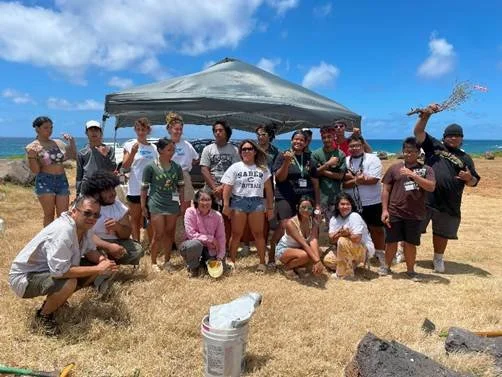
HOSA conservationists at Wāwāmalu Beach
By Reese Liggett, Oʻahu Group Outings Leader
The Oʻahu Group hosted another HOSA group at Wāwāmalu Beach for a special service day on Saturday, December 6, this time welcoming students from Punahou School and a handful of dedicated conservation-minded volunteers.
HOSA—Health Occupations Students of America—has chapters in nearly every Honolulu school and several youth organizations. Our previous HOSA outing featured students from Kōkua Kalihi Valley (pictured with Outings Leader Suzan Harada, kneeling in pink).
The Oʻahu Group Outings program has now led monthly conservation workdays at Wāwāmalu Beach for 38 of the past 39 months, engaging more than 600 volunteers in restoring this section of the Kaiwi coastline from an off-roading racetrack back into thriving native habitat. The next workday is Sunday, December 21, marking outing #39.
Join us behind the boulder barrier and help continue this restoration journey!
More details at sierracluboahu.org/hike
Upcoming Outings
Sunday, December 14
Mālama Tree Crew: Pālehua Service Project
Join us to clear debris, weed, and water around 75 newly planted native trees in the Akupu Enclosure in the Gill Ewa Lands (GEL). GEL encompasses 1,600 acres in the southern tip of the Waianae mountains dedicated to preserving the lands important biological, cultural, economic and historical resources. The Akupu Enclosure provides habitat for endangered ʻelepaio to nest. Meet at 7:45am at Makakilo Community Park, near the top of Makakilo Drive. We will work from 8am-11pm. To help you prepare, we suggest wearing long sleeves, pants, and closed toe shoes. Although we provide tools, you might prefer to bring your favorite tool and gloves. Remember to pack water, a snack, and insect repellent. Reservations are required at least one day prior. Contact sherrycassetta@gmail.com to RSVP with your full name and phone number.
Leader: Sherry Cassetta
Sunday, December 21
Wāwāmalu Service Project
Join us for the third Sunday at Wāwāmalu. Limited to 25 participants out of concern for the delicate planting environment. Participants under 18 require a parent or guardian. We will be encouraging native vegetation through weeding, native seed gathering, and sowing, as well as offering interpretation of the native ecosystem for those interested. Please bring closed toe shoes or boots, gloves, sunscreen and a water bottle. Meet at 9am, finish at noon. Water for refills will be provided. Contact wrliggett@yahoo.com to RSVP.
Leader: Reese Liggett
Sunday, December 28
Pālehua ʻElepaio Enclosure Akupu Service Project
We will be clearing alien invasive plants like lantana, strawberry guava, lilikoi, thimble berry, coarse asparagus fern, trail building, outplanting and watering native plants to restore the native habitat for the endemic Oʻahu ʻelepaio. Space is limited as we will be working in a sensitive area where the endangered native ʻelepaio is nesting and there are some native plants already growing which we don’t want to disturb or damage. We may hear and see some native ʻelepaio as we work in the area, so bring a camera as well. Bring gloves and hand tools for weeding alien plants if you have any. Pack water and a snack and definitely mosquito repellent. We plan to meet in Makakilo at 8:30am and finish by 1pm. Reservations required at least one week prior. Contact Clyde Kobashigawa, clydekobashigawa@hawaii.rr.com, for reservations with first and last name and phone number. Please indicate any person who is a minor.
Leader: Clyde Kobashigawa