
Red Hill Updates: Will Our Wai Ever Be Healed?
By Wayne Tanaka | Reading time: 7.5min
This fall, community groups, the Board of Water Supply, and the Honolulu City Council continued to push for greater transparency and action from the Navy and regulators alike, as new PFAS detections and limitations on current remediation strategies have raised serious doubts as to whether the Navy will ever clean up the Red Hill Facility’s contamination in our wai.
Meanwhile, experts and community members have also expressed concerns about the planned reopening of the Navy’s long-shuttered ‘Aiea-Hālawa drinking water shaft, and whether this may risk exposing Navy drinking water system consumers to PFAS “forever chemicals,” jet fuel, and other toxic contaminants.
Read on for a rundown on the most recent Red Hill developments and updates from the last two months.
BWS PFAS Detections Raise Alarms, City Council Responds
In July, the Honolulu Board of Water Supply (BWS) reported that PFAS “forever chemicals” found in its wells to the west and northwest of the Red Hill Bulk Fuel Storage Facility were of the same type as those found in the Navy’s wells underlying Kapūkakī (Red Hill). This indicated that the long-feared westward migration of contaminants from the Red Hill Facility may be occurring, placing additional drinking water wells at risk in the years and decades to come.
In light of this latest development, the BWS repeatedly requested that the EPA, DOH, and the Navy increase the sampling and testing of PFAS and petroleum chemicals in the Navy's wells - requests that the EPA has repeatedly denied.
Ironically, the EPA has told the Navy every year since 2024 that more testing, and more data, is necessary to understand the extent of PFAS and other contamination from the Navy’s Red Hill Facility, and the threats this contamination may pose to our environment and drinking water system.
Given the EPA’s and Navy’s inexplicable refusal to collect and provide more data, the Honolulu City Council unanimously adopted Resolution 26-193, urging the EPA and Hawaiʻi Department of Health to require that the Navy increase the frequency, scope, and geographic extent of groundwater testing for PFAS and petroleum chemicals. Mahalo nui to the City Council and over two dozen testifiers who helped ensure this resolution’s passage.
It is unclear whether and how the EPA and Navy will respond to the demands of the entire City Council, BWS, and Oʻahu residents, although responses from Commander Ben Dunn at the most recent Navy Town Hall were not encouraging (read more below).
Remediation Expert Presentation to Red Hill CRI
In August, the Red Hill Community Representation Initiative (CRI) received a much-anticipated presentation by former EPA hydrologist and Superfund specialist Dr. Eva Davis. This presentation was a follow to her prior presentation on the Navy’s remediation efforts to clean up the jet fuel released from the Red Hill Facility. Diving deeper into the applications and limitations of various remediation strategies, Dr. Davis did discuss a possible technique that could remove the jet fuel in our environment orders of magnitude faster than the Navy’s current approaches: thermal remediation.
Unfortunately, even with new strategies like thermal remediation, we may never be able to fully clean up the contamination of our sole source aquifer - meaning that costly groundwater monitoring and drinking water filtration systems may be needed indefinitely, to protect Oʻahu water drinkers now and for generations to come.
You can watch Dr. Davis’s Red Hill CRI presentation on Youtube here.
House of Representatives Special Committee on Red Hill Meeting with the Navy Closure Task Force-Red Hill
Also in August, the House of Representatives Special Committee on Red Hill received updates from the Navy Closure Task Force-Red Hill (NCTF-RH), including its new commander Rear Adm. Lester Ortiz. Fortunately, committee members including Chair Linda Ichiyama, Representative Della Au Belatti, and Representative Garner Shimizu were able to ask some critical questions that dug deeper into what the NCTF-RH presented. High level takeaways from the meeting, which has a recording available online, include:
We still don’t know if or how our wai will be healed. Five years after the Nov. 2021 disaster, the Navy still does not know how they are going to clean up the contamination released from the Red Hill Facility, or how long it will take.
Current environmental remediation strategies do not address jet fuel in the aquifer. Commander Ben Dunn admitted to Chair Ichiyama that the Navy’s soil vapor extraction efforts (vacuuming up fuel vapors from the soil) are only for jet fuel contamination above the aquifer - not in the groundwater itself.
Future remediation techniques will take years to research. The only remediation "pilot studies" mentioned were for soil vapor extraction, and to see whether and how the jet fuel in the aquifer is breaking down "naturally." A University of Hawaiʻi study is still just looking at what kinds of microorganisms appear to be “eating” petroleum hydrocarbons at fuel spill sites on Oʻahu. Similar studies may take years to be completed, raising the question as to how long it will take to research and develop, much less deploy, other remediation strategies.
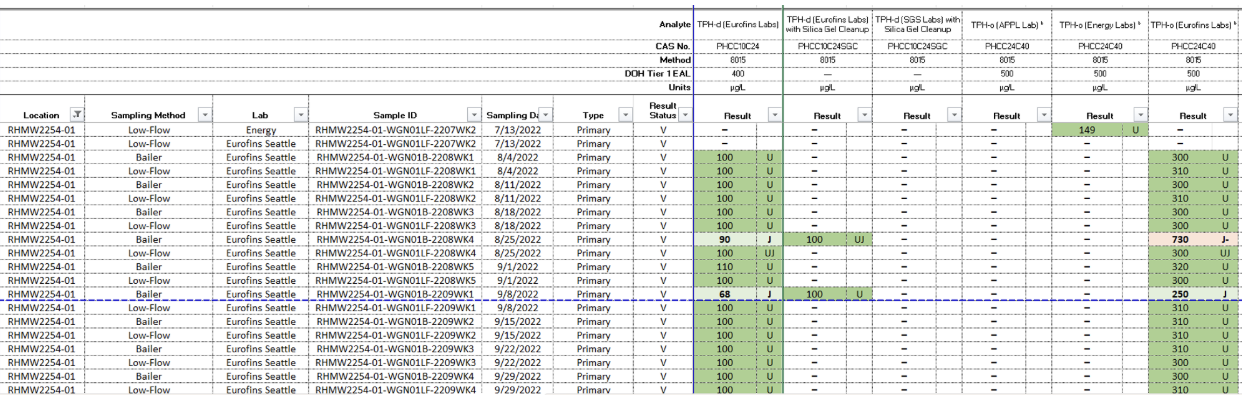
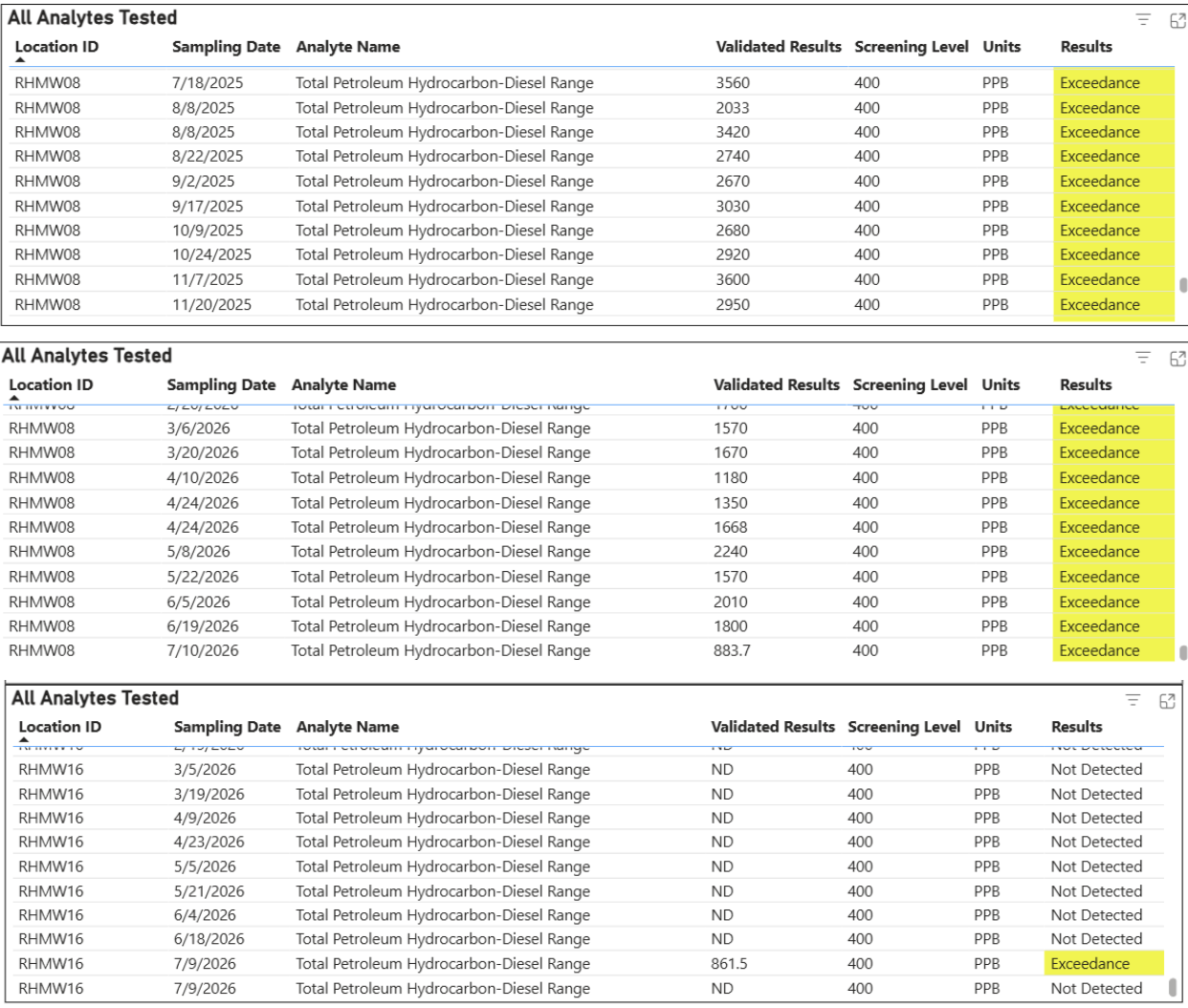
NCTF-RH continues to make claims that there is “no evidence” of contaminant migration. Legislators were told that there was "no evidence" of contamination moving in the groundwater below the Red Hill Facility. However, as described above, the same types of PFAS found in the Navy’s wells at the Red Hill Facility have been found in BWS wells far to the west and north of Kapūkakī. The Navy’s own data also shows sporadic TPH detections in its monitoring wells far to the west and northwest after the 2021 spill, in 2022, 2023, 2024, and 2025 (RHMW04B, RHMW08, RHMW12, and RHMW16).
Navy water monitoring data shows how total petroleum hydrocarbon-diesel range detections at a monitoring well far to the west of the Red Hill Facility (RHMW08) increased significantly in the years following the 2021 catastrophe, with monitoring wells to the north and northwest also showing spikes in hydrocarbon detections as recently as 2026.
Despite the Navy’s own data and other limitations and irregularities with its sampling methods, NCTF-RH continues to claim there is “no evidence” of contaminant migration.
Evidence of “jet fuel being degraded” only raises more questions. Commander Dunn also stated that they are seeing signs that jet fuel below the Red Hill Facility is being biodegraded. Unfortunately, he did not provide more details about the evidence they have. Is the NCTF-RH finding actual constituents of degraded fuel (which can be more toxic than jet fuel itself), and what are they? If so, how can we tell if these are from the November 2021 spill or the many, many older spills that occurred at the Red Hill Facility over the decades? Most importantly, how fast is this degradation occurring, and how long will it take for the environment to clean itself if we just wait for the fuel to "naturally attenuate" i.e. be biodegraded into non-toxic constituents (note: PFAS also does not naturally attenuate)?
Navy Closure Task Force-Red Hill Town Hall and ʻAiea Hālawa Shaft Reopening
Finally, on August 17, NCTF-RH held a “Town Hall” alongside the EPA to provide updates and answer questions about their work in environmental remediation, Red Hill facility closure, and drinking water safety. An audio recording of the Town Hall, including community questions, can be heard here.
Clearly top of mind for most of the community members in attendance was the announcement of the reopening of the Navy’s ʻAiea-Hālawa drinking water shaft, which has been approved without an environmental assessment, and which relies on an experimental filtration system that was designed for PFAS, not jet fuel.
Despite the invitation from NCTF-RH Commander Ortiz to bring “technical questions” to the town hall, time limitations and evasive nonresponses provided the usual barriers to getting meaningful answers from the Navy. For example:
Despite conflicting past interpretations of total petroleum hydrocarbon (TPH) detection data between the Navy and EPA, and the lack of an EPA conclusion regarding the source of the TPH detections at the ʻAiea Hālawa shaft, neither the Navy nor the EPA would commit to delaying the reopening of the shaft until these detections were further analyzed.
The Navy did not respond directly to a question concerning whether they would heed the call of the Honolulu City Council or BWS to expand the scope and extent of its groundwater monitoring program, despite sporadic detections of PFAS, total petroleum hydrocarbons, and even legacy pesticides that suggest these contaminants may be moving in the groundwater (and potentially, toward the reactivated ʻAiea Hālawa shaft).
The Navy failed to describe how it will monitor and ensure that the property manager for Kapilina Beach Homes, the civilian neighborhood served by the Navy’s water lines, updates its residents about their water system, including on the ʻAiea Hālawa shaft reopening.
Other questions that were submitted but not asked included:
Why does the Navy continue to claim that the Red Hill contamination is not migrating, despite evidence, including its own data, suggesting otherwise?
What is the rapid water test that is being used to investigate drinking water complaints, and where exactly on the Navy’s “Safe” Waters website is it described?
Why were numerous water samples ordered to be re-tested for weeks or months after their holding times had elapsed, rendering them unreliable as water samples?
Why does Navy water testing largely rely on low-flow samples, instead of bailer samples, when bailer samples are more likely to have higher levels of petroleum hydrocarbons?
Will the Navy ever follow the EPA’s recommendation to keep investigating the cause of ongoing water complaints, even if petroleum hydrocarbons are ruled out as the reason for the complaint?
What is the specific evidence of “natural attenuation” of jet fuel that the NCTFRH claims is happening, and how do we know if this evidence is from the 2021 jet fuel spill, instead of the decades of prior spills at the Red Hill Facility?
How long will it take to remediate the Red Hill Facility’s contamination of the environment, using current remediation methods?
As these questions demonstrate, there is still a great need for transparency, accountability, and answers from the Navy. The Red Hill Community Representation Initiative (CRI) previously provided a unique and important opportunity for the community to have the deep dive conversations necessary to meet these needs. Unfortunately, the Navy’s refusal to honor its prior commitment to meet regularly with the CRI has now led to extremely limited information sharing opportunities that only raise more questions than the few that are answered in a meaningful and non-evasive way.
Whether and how the new NCTF-RH leadership will reconsider its current, unsatisfactory community engagement approach remains to be seen.
Save the Date: Red Hill Community Representation Initiative Meeting
Finally, for those interested in learning more about the questions and concerns surrounding the Navy’s reopening of its ʻAiea Hālawa shaft, be sure to mark your calendars for the next Red Hill CRI meeting on October 22, 2026 from 5 p.m. - 7:30 p.m. CRI members and Sierra Club of Hawaiʻi Director Wayne Tanaka will discuss the issues identified by community members and outside experts. Follow @redhillcri23 on Instagram for meeting details and updates.