
Group News: Hawaiʻi Island Group, Maui, and Oʻahu
Hawaiʻi Island Group
Solar vs Geothermal By the Numbers
By Stephen Holmes, HIG ExCom Member & Former US Department of Energy National Energy Champion
Geothermal continues to be pushed in Hawaiʻi as an energy solution, even when the economics don’t add up.
Because geothermal is still a marginal technology that relies on government subsidies, it doesn’t attract significant private investments and puts financial risk on ratepayers and taxpayers. There are current efforts to secure millions of dollars from the Legislature to fund geothermal exploration. It costs around $5-6 million per well and they need around 6 wells just to “prove the resource”. This level of expense is totally unnecessary with solar.
There are also hidden costs, such as capacity charges. Puna Geothermal (PGV) recently secured a new power purchase agreement that includes significant increases in capacity charges, which are added to base electricity rates. Solar projects generally do not carry comparable charges.
Location is another factor. Geothermal facilities are typically far from where energy demand is highest, leading to greater line losses (loss of energy during transmission, mainly due to resistance in the conductors) and higher transmission maintenance costs, expenses ultimately borne to ratepayers. Solar, by contrast, can be decentralized and installed closer to where electricity is used, reducing these losses and infrastructure costs.
Maintenance requirements also differ. Geothermal plants must be periodically shut down for maintenance, which means additional power generation must be available on standby, another cost to consumers. Solar systems require comparatively little maintenance, and their modular nature allows panels and batteries to be replaced without fully interrupting power generation.
In the energy industry, the common comparison metric is LCOE, or levelized cost of energy. By this measure, geothermal is often estimated to be roughly twice as expensive as solar. Meanwhile, solar panel and battery costs continue to decline due to rapid global deployment. Upfront investment costs for solar and battery storage are also typically lower.
Insurance presents yet another challenge. Many private insurance companies won’t cover geothermal facilities because they are viewed as too risky. PGV, for example, is structured as an LLC and disclosed in its most recent PUC contract that it is self-insured, since the private insurance market is unwilling to provide coverage.
Solar with battery storage also offers operational advantages. Stored electricity can be shifted to peak demand periods with high efficiency, and solar systems can respond almost instantly to fluctuations in energy needs. Geothermal plants, on the other hand, are less flexible in ramping output up or down in response to demand.
Supporters of geothermal often emphasize its potential benefits, but cost competitiveness remains a central concern. That means elected officials promoting geothermal either don’t understand the economics or they are just fine running up your electric bills.
Hawaiʻi’s Reefs Are Not a Supply Chain: Why the Aquarium Trade Must End
By Kara Dumaguin, Hawaiʻi Island Group Vice-Chair
In recent weeks, a resolution before the Hawaiʻi County Council urged the State of Hawaiʻi to prohibit the commercial harvest of reef animals for the aquarium trade. The message is clear. Our reefs are already under pressure from climate change, pollution, and overuse, and the aquarium trade adds an avoidable burden to ecosystems that need every chance to recover.
This county action matters for two reasons. First, it reflects what many community members, cultural practitioners, and ocean users have said for years. Reef ecosystems are not meant to function primarily as inventory for export markets. Second, it comes at a moment when state decisions could once again expand aquarium collection in West Hawaiʻi, despite the long history of controversy and community opposition surrounding the practice.
The aquarium trade in Hawaiʻi targets reef animals, especially colorful and iconic fish, captured from nearshore waters for export to the global pet industry. This is not subsistence fishing, cultural harvest, or local food gathering. It is commercial extraction from public trust resources for private profit.
This distinction matters. Fishing for food, culture, and community has sustained Hawaiʻi for generations and remains an essential part of island life. Responsible local harvest connects people to place, supports families, and reinforces stewardship. The aquarium trade is fundamentally different. While many people appreciate marine life for education and enjoyment, this industry is not rooted in feeding communities or sustaining cultural practice. It is primarily about removing living reef animals from public waters to supply an export market.
Supporters often describe the trade as managed and sustainable. But management on paper is not the same as healthy reefs in real life. Reef fish play essential roles in coral reef ecosystems. They graze algae, recycle nutrients, and help reefs remain resilient in the face of warming seas and coral bleaching. Removing large numbers of fish, especially from localized areas, can disrupt ecological balance in ways that ripple through the entire system. Recovery is not guaranteed as climate change continues to stress reefs across Hawaiʻi.
Legal permission does not automatically equal responsible practice. Hawaiʻi’s nearshore waters are held in trust for the public, for future generations, and for the health of the ecosystems themselves. Treating reef fish primarily as commercial commodities rather than living components of an interconnected system reflects a worldview increasingly out of step with science, climate realities, and Indigenous stewardship traditions.
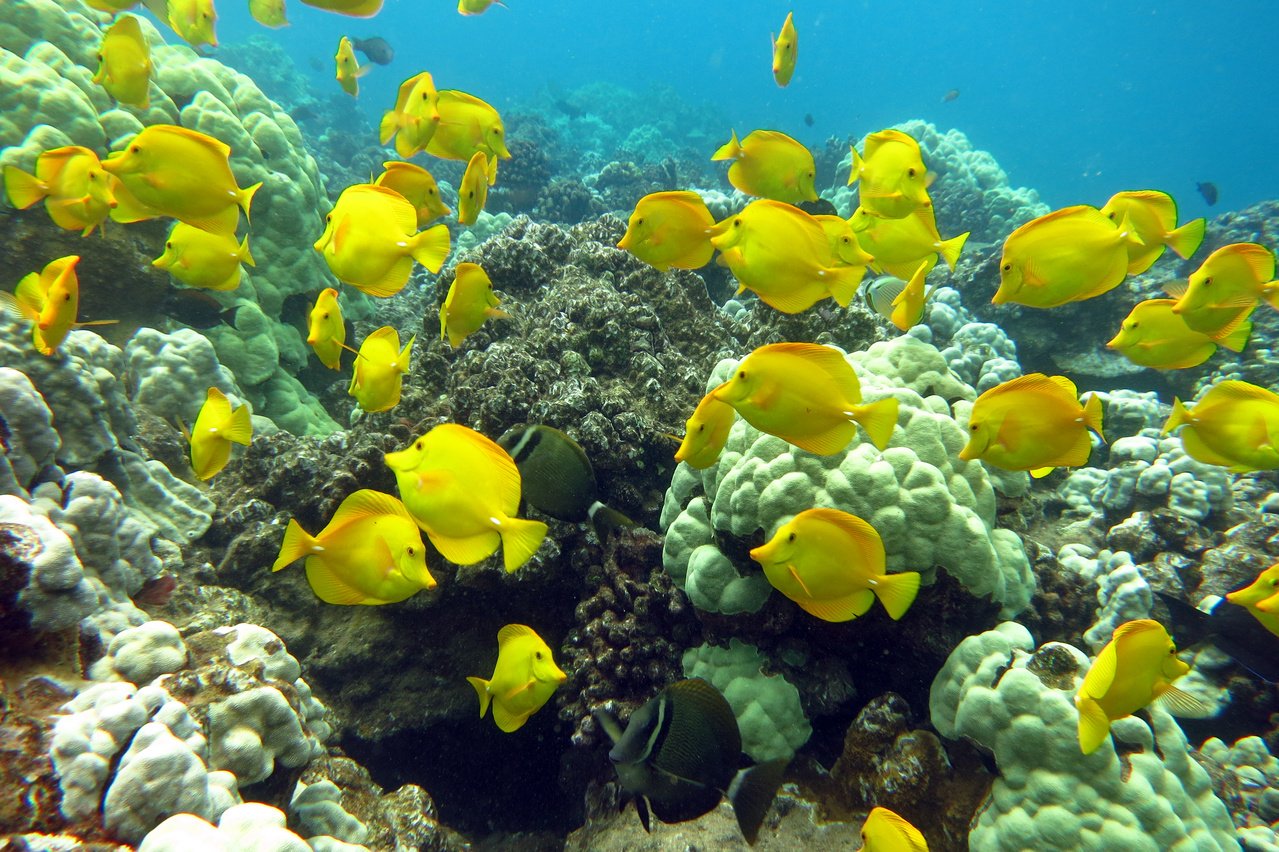
Photo: NOAA
This is why the Hawaiʻi County Council’s action is significant. While the resolution does not change state law, it sends a clear signal. Local governments are calling on the State to take responsibility for protecting reef ecosystems by ending commercial aquarium collection in state waters.
What do we owe these places that feed us, protect our shorelines, and shape our identity? Reefs are living infrastructure for Hawaiʻi. They sustain local fisheries, cultural practice, and everyday relationships with the ocean. Reef fish are part of that system, part of the knowledge and connections that sustain nearshore ecosystems.
Allowing commercial extraction for aquariums normalizes a model where living reef communities are treated primarily as export commodities. That approach is incompatible with mālama ʻāina. It also ignores a simple reality. We do not need this industry to thrive as an island state. People who love marine life can support reef safe tourism, visit educational aquariums that prioritize ethical sourcing, and advocate for policies that keep wild ecosystems functioning and abundant.
The County’s resolution now places responsibility squarely at the state level. Meaningful protection will only come through statewide policy that permanently ends commercial aquarium collection in Hawaiʻi waters. Without that clarity, the state risks repeating cycles of conflict and ecological uncertainty while reef ecosystems continue to degrade.
We can recognize that restraint is stewardship. We can affirm that public trust resources should serve public good, not private export markets. And we can align Hawaiʻi’s marine policy with the realities of climate change, reef decline, and our responsibility to future generations.
Protecting reefs does not mean removing people from the ocean. It means being intentional about how we use it. Fishing for food, culture, and community has always been part of Hawaiʻi’s relationship with the sea. Those practices, when grounded in knowledge and restraint, strengthen both people and place.
The question before us is not whether humans belong on the reef. We do. The question is whether extracting reef life for export serves the long-term health of these ecosystems and the communities who depend on them.
Hawaiʻi’s reefs are not a supply chain. They are a shared inheritance. Protecting them means choosing uses that sustain abundance, support local livelihoods, and keep reef ecosystems resilient for generations to come.
Tribute to Former Hawaiʻi Island Group Executive Committee Chair, Dr. Phil Barnes
By Hawaiʻi Island Group Executive Committee

Former Hawaiʻi Island Group Executive Committee Chair Dr. Phil Barnes passed away in his beloved Hilo, Hawaiʻi on January 19, 2026. He was born in Indianapolis on April 29, 1945, to William Barnes Sr. and Cecilia Doyle Barnes, and graduated from Cathedral High School. His father was a forester, so the ʻulu didn’t fall far from the tree.
Phil was a gentleman and a scholar who brought depth of knowledge, experience, and wisdom to every endeavor he undertook. A lifelong student of biology and history, Phil earned his bachelor's degree from Purdue University, his master's from Indiana University, and two doctoral degrees from the University of Miami. He spent thirty years as an educator and was a founder of the Learning Unlimited program at North Central High School in Indianapolis. Phil later spent more than a decade teaching Hawaiian Studies and authored A Concise History of the Hawaiian Islands.
In addition to his leadership role with the Sierra Club, Phil was a past chair of the Hawaiʻi Island Democrats and a member of the Hawaiian Historical Society. He also supported Down Syndrome of Louisville and the Kindness Warrior Walk—especially the Will's Walkers team—in honor of his grandson.
Phil lived a full and remarkable life. He was supremely proud of his daughter Brooke and grandson Will. A passionate world traveler, he and his wife Diane visited all seven continents, from an African safari on their honeymoon to trekking in the Himalayas and hiking the Appalachian Trail. An avid hiker and birder, Phil served as a Hawaiʻi Island Group outings leader and was arguably the best personal tour guide on Hawaiʻi Island. He also hiked and kayaked throughout Hawaiʻi with fellow Sierra Club members. He was the founder of Eco Expeditions and was a longtime paddler with the Kamehameha and Laka canoe clubs.
Phil also loved sports, particularly the Colts, Pacers, and Indiana University teams. Phil's first act beyond the veil may have been securing IU's first national championship and undefeated football season.
Phil is survived by his wife, Diane Fournier, of Hilo, Hawaiʻi; his daughter Brooke Barnes and grandson Will of Cincinnati, Ohio; his brothers John Barnes (Kelly) of Verona, Wisconsin, and Bill Barnes (Lucy) of Sioux Falls, South Dakota; as well as numerous nieces , nephews, and cherished extended family and friends.
A celebration of life will be held at a later date. In lieu of flowers, donations in Phil's memory may be made to the National Audubon Society: https://www.audubon.org/.
To plant trees in memory, please visit the Sympathy Store.
Kānāwai: A Living Guide for Mālama ʻĀina
By Kara Dumaguin, Hawaiʻi Island Group Vice-Chair
In times of increasing environmental strain, frameworks that help guide decisions about land, water, and community become especially important. Now, as the state Commission on Water Resource management and the community walaʻau (discuss) and kūkākūkā (negotiate) the Keauhou Aquifer System Area Groundwater Adaptive Management Plan, it is important to remember an overarching essential word and concept, kānāwai.
Kānāwai is often translated simply as law, but its deeper meaning reaches far beyond rules written on paper. At its heart, kānāwai speaks to pono, a state of righteous relationship and integrity that guides how we move through the world. From that sense of pono comes balance, reminding us that the flow of wai (freshwater) shapes the flow of life, and that our actions as people must remain in alignment with the natural systems that sustain us.
Kānāwai offers a lens that is both ancient and urgently relevant today. Rather than focusing only on enforcement or punishment, kānāwai asks us to consider responsibility, restoration, and the consequences of imbalance. When imbalance happens, the focus shifts toward restoring pono through thoughtful action and renewed relationship.
Human impact on ʻāina (life-sustaining land) and kai (seawater) is undeniable. From changing coastlines to shifting ecosystems, our choices shape the future in ways that can either restore balance or deepen disruption. Kānāwai encourages us to move beyond extraction and toward reciprocity. It invites us to recognize that caring for the environment is not a separate activity from daily life, but a continuation of our relationships with place, ancestors, and future generations.
In many environmental conversations today, we often hear the language of policy, regulation, and compliance. These tools have their place, yet kānāwai reminds us that true stewardship begins with values. It calls us to listen closely to the rhythms of the natural world, to act with humility, and to understand that our kuleana (responsibility) extends beyond individual gain. Decisions about conservation, resource management, and community wellbeing become more meaningful when they are grounded in a sense of relational accountability.
Kānāwai is not only something we look back to. It is something we practice. Each time we choose to deepen our relationship with ʻāina through care, reciprocity, and learning, we are living its principles. In this way, kānāwai becomes a living guide for navigating the complex environmental challenges of our time.
As we continue the work of mālama ʻāina, may we remember that law is not only about boundaries. It is also about pono, flow, connection, and the shared responsibility to keep balance alive for those who come after us. These reflections are offered in the spirit of mālama ʻāina, as one way of thinking about how we continue caring for the world around us together.
2026 Hawaiʻi Island Group Awards: Hawaiʻi District Science & Engineering Fair
By Deborah Ward, Hawaiʻi Island Group Member
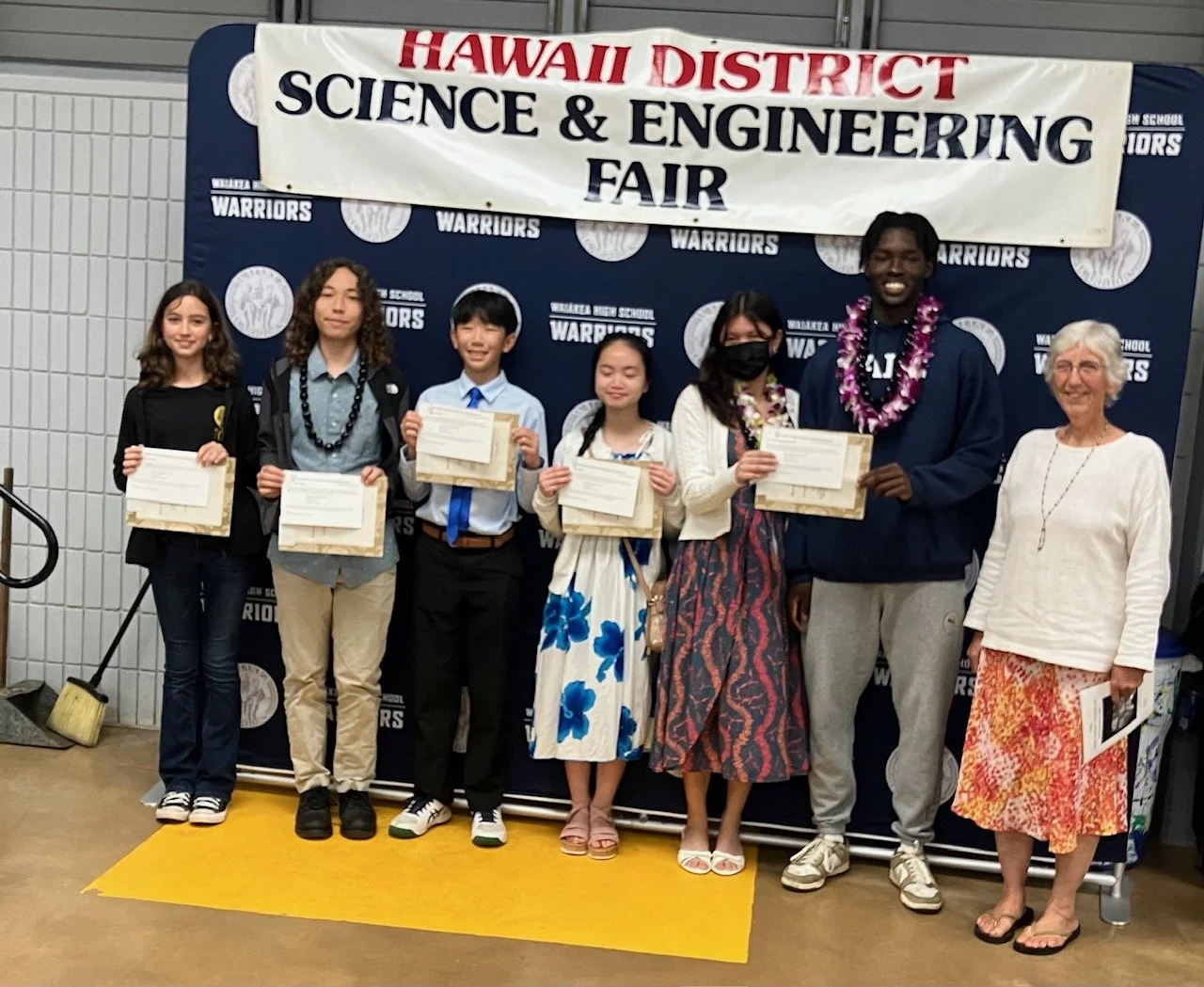
Every year since 1995, the Hawaiʻi Island Group has presented monetary awards and certificates to outstanding young scientists whose projects focus on Hawaiʻi’s environment. These awards are dedicated to Sierra Club members whose scientific contributions have made a historic, positive—and sometimes political—impact in Hawaiʻi.
As we do each year (with the exception of the pandemic years), our members gathered to evaluate the many inspiring presentations.
Mahalo to the organizing committee and to science fair judges Deborah Ward, Lanny Sinkin, and Yoshika Fujimoto for their assistance. Members who would like to support our future young scientists are encouraged to donate to the Hawaiʻi Island Group here.
Congratulations to the following young scientists!
Ariala M. Rosam: Ms. Mae Mull Award
Impact of Microplastic on the Surface Temperature of Sand
Abby N. Huynh: Dr. Wayne Gagne Award
Making Hawaiian Plant-Based Bioplastic: How much can it withstand?
Ren Aragaki: Dr. Ruth Lani Stemmermann Award
Prepare for trouble and make it double: Using two entomopathogenic agents to control the two-lined spittlebug
Austyn O. Bugado & Bryan A. Assi: Hawaiʻi Island Group Award
Investigating Heavy Metal Contamination Effects of Sugar Cane Farming on Hawaiʻi Island Soil: Developing a Map of Arsenic and Lead Contamination
Ben Yamaki: Dr. Don Worsencroft Award
Merging Galaxy Systems
The Hawaiʻi Island Group is incredibly proud of these next generation scientists and we hope you consider supporting them too.
Maui Group
Community Science and Partnerships Help Gather Important Stream Data
by Raina Myers, Maui Group Volunteer Coordinator
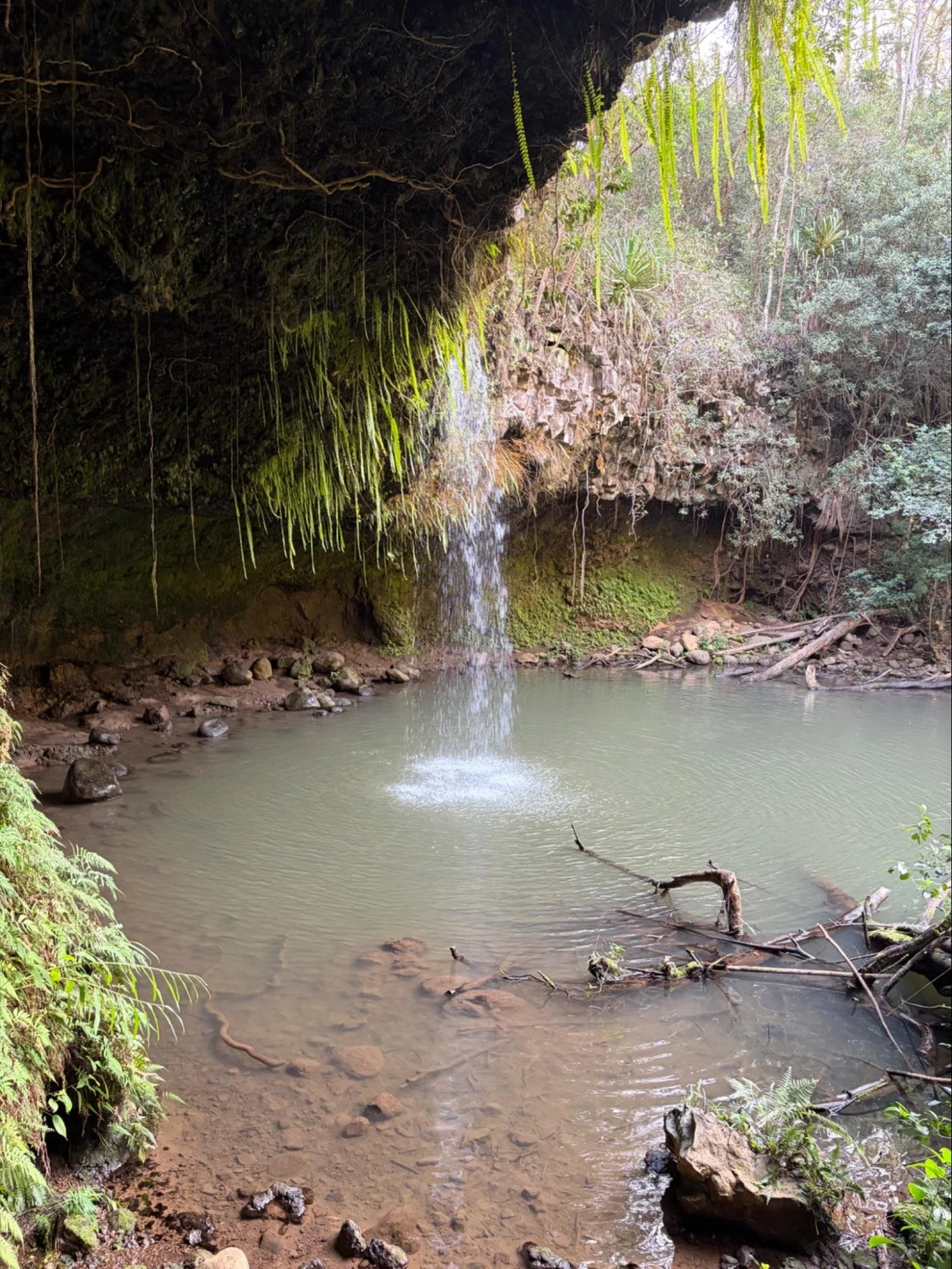
The Haʻikū Community Association’s Stream Monitoring Program exemplifies what is possible when community care, science, and strong partnerships come together in service of wai. From its roots as a volunteer effort to its current role as a collaborative, multi-partner monitoring program, this work reflects a shared commitment to understanding and protecting East Maui’s freshwater resources.
My path into stream monitoring began when I learned that I was living in the ahupuaʻa of Honopou, and that this watershed was benefiting from restored stream flow. I began to see how intentional stewardship and long-term advocacy could meaningfully improve stream health. That realization sparked a desire to become involved in work that could help expand those benefits to other streams across East Maui.
In 2022, I began volunteering with Tara Apo-Priest through the Sierra Club Maui Group, supporting her work monitoring streams in Haʻikū and Huelo. At the time, the effort was volunteer-powered and rooted in a shared concern for public health, freshwater ecosystems, and community access to information. What stood out immediately was the value of simply showing up consistently, collecting data, and paying attention to how streams respond to rainfall, flow, and seasonal change.
As monitoring continued, it became clear that one-off sampling was not enough. Understanding patterns requires time, consistency, and community trust. Stewardship of the monitoring effort eventually transitioned to the Haʻikū Community Association (HCA), allowing the work to expand into a more structured, community-led program. Today, I work as the field technician for the HCA Stream Monitoring Program.
We now monitor four primary streams weekly—Nāʻiliʻilihaele, Kailua, Honopou, and Hoʻolawa—and sample additional sites when streamflow allows. Between 2024 and 2025, we collected over 300 water quality samples, focusing on indicators related to human health as well as stream ecosystem conditions.
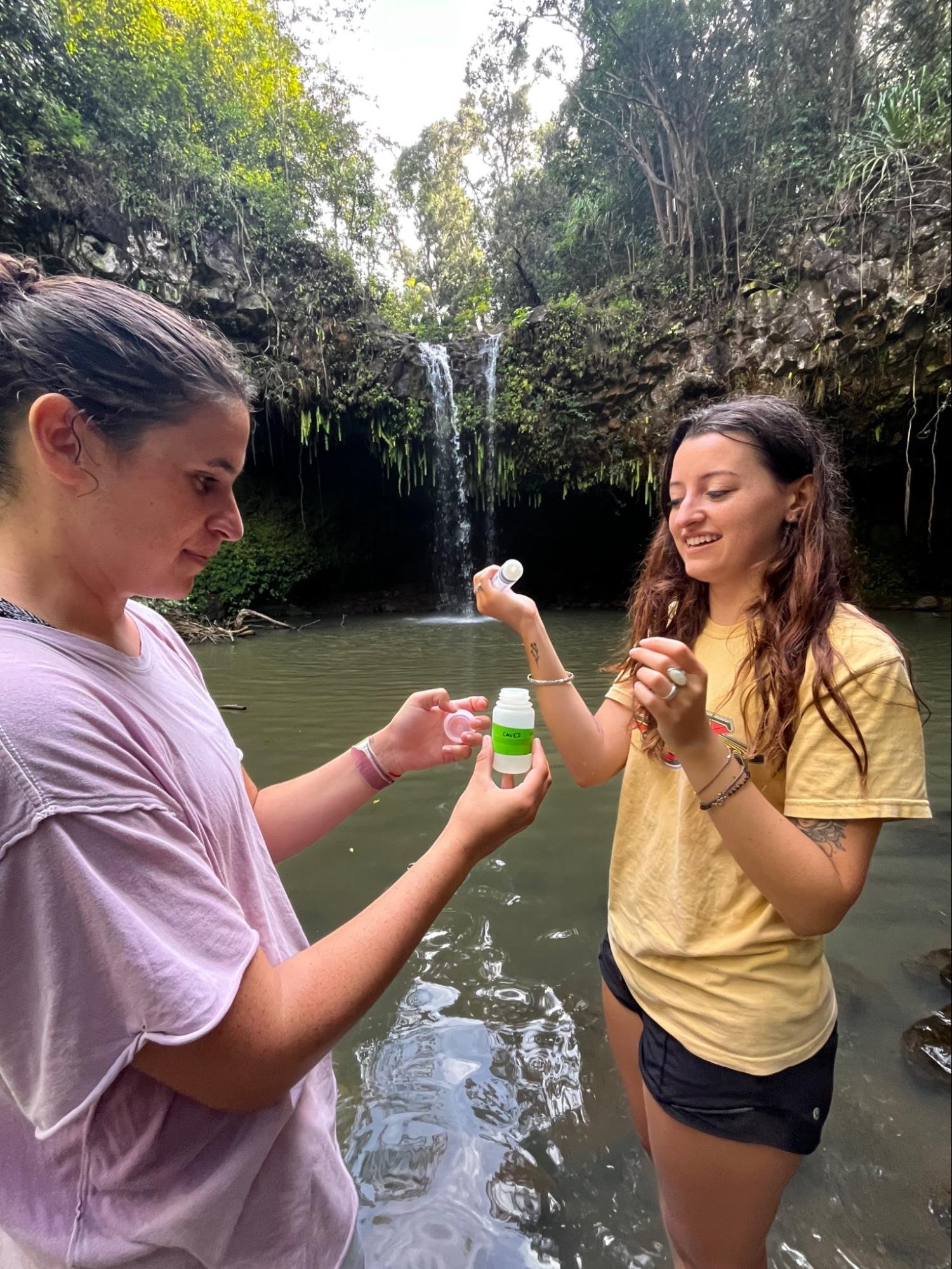
The Sierra Club Maui Group continues to play a critical role in this work by lending essential monitoring equipment, including a YSI multiparameter water quality meter and a turbidity meter. This equipment was purchased after receiving a generous donation by Lori Grace of Hale Akua in Huelo. Access to professional-grade tools ensures that community-collected data meets Hawaiʻi Department of Health guidelines and scientific standards.
Our dedicated water lab space is hosted by Friends of Twin Falls at Wailele Farm. This space allows for efficient sample processing and serves as a hub for training and collaboration. Friends of Twin Falls are also expanding their youth-focused education programming, teaching keiki about watershed health, stream ecology, and responsible recreation. Pairing monitoring with education strengthens long-term stewardship and connection to place. A new grant from East Maui Water Authority will expand this youth centered program, testing streams further mauka.
Academic partnerships further enhance the program. The UH Maui College Water Quality Lab processes our Dissolved Inorganic Nitrogen (DIN) samples, providing insight into nutrient dynamics and ecosystem conditions. We also work alongside a University of Hawaiʻi at Mānoa graduate student researching pesticide levels in East Maui streams, helping broaden understanding of land-use impacts on water quality
Results from 2024–2025 show that typical bacteria levels are generally below Hawaiʻi Department of Health freshwater recreational guidelines, with short-term exceedances most often occurring during or after rainfall and muddy run-off entering streams. Conditions vary by stream, reinforcing the importance of long-term, watershed-specific monitoring.
This work is made possible through generous support from the County of Maui Office of Economic Development, the County of Maui Environmental Protection and Sustainability Division (which funded the IDEXX machine), the Teran James Young Foundation, the Beth Savitt Family Foundation, and Friends of Twin Falls, alongside community and technical partners including DAR, UH researchers, Sierra Club Maui, and Surfrider Foundation Maui.
Healthy watersheds thrive when knowledge is shared. Mahalo to all who help keep the data, education, and care flowing!
Keep Up With the Project:
Weekly Water Quality Results: https://www.haikumaui.org/haiku-water-quality/
HCA Newsletter: Sign up by emailing haikucommunitypm@gmail.com
Instagram: @haikustreamsproject
Upcoming Outings
Saturday, April 18
Pa‘uwela Point and Kuiaha Bay
North Shore, 4 miles
Moderate, some uphill and downhill. This outing combines a visit to Pa‘uwela Point with its cliff-side views and tidepools with a detour to the historically rich Kuiaha Bay, a hidden gem along the Ha‘ikū coastline. The valley had restoration work in the past to traditional farming by the Waikikena Foundation. Hiking down to the tidepools is optional. Limit 18. Meet 8am Haiku Community Center. Leader: Rob Weltman, robw@worldspot.com
Sign up
Sunday, April 19
Hawai’i Land Trust Nu’u Refuge Work and Hike
Kaupo, 2.5 miles
Join us for a fun day of field work, guided hiking, and possible optional swim at Hawai’i Land Trust’s Nu’u Refuge in Kaupō. We will do some native tree and shrub planting and weeding from 9:00 AM to 12:00 noon, and then join Scott Fisher for a guided hike around the property, which may include a bay swim if ocean conditions are conducive. Meet to carpool at 7:30 AM at Pukalani Terrace Center near Ace Hardware or meet at 9:00 AM at Nu’u Refuge (Nu’u Bay in Google Maps). Coming from ‘Ulupalakua, it is about 2/10 of a mile before Mile Marker 31 on the Piʻilani Highway in Kaupō. Please wear closed shoes, like sneakers or boots, and bring a water bottle, a snack, sun protection, gardening/work gloves if you have them, and a swimsuit if interested in possible bay swim. Limit 60. Leader Annie Schultz, acm_schultz@hotmail.com or 808-344-6628.
Sign up
Sunday, April 26
Kapalua Coastal Trail hike and farewell to our beautiful Kōlea
West Maui, 3.5 miles
Meet in the D.T. Fleming Beach Parking Lot, left side, at 8am. We will walk along the coastal path, a combination of asphalt, gravel, and rocky trail. This should be a great opportunity to photograph our beautiful Kōlea (Pacific Golden Plover) gathering on the grassy lawns in their elegant breeding plumage in preparation for their 3,000-mile en masse migration to their breeding grounds on the Arctic tundra. After a stop at Kapalua Bay for lunch and optional swim/snorkel, we will return to Fleming Beach. Although the footing can be rough in places, this is an easy three and a half mile RT hike. There are restrooms at each end of the walk. There will be an optional detour to Makaluapuna Point on the way back to see the jagged rock formation known as Dragon’s Teeth and to walk the labyrinth for those interested. Swimming and snorkeling are excellent at both DT Fleming Beach and Kapalua Bay, so bring appropriate gear if you wish. Snack/lunch on the beach at Kapalua Bay. Bring water and reef-safe sun protection. Leader Annie Schultz, acm_schultz@hotmail.com or 808-344-6628.
Sign up
Sunday, April 26
Hana‘ula Ridge hike and service outing
Māʻalaea, 1 miles
Help Maui Cultural Lands maintain native plant habitat on state land near Kaheawa Wind Farm. Panoramic views and beautiful ‘ōhi‘a. Information from our host here. Covered shoes, long pants, clothes you don’t mind getting dirty, rain jacket. Bring lunch and gloves. Meet 9:00 am at Ma‘alaea Ocean center parking lot (Carl’s Jr. end). You will need to fill out a host waiver in advance here . Or to print and bring signed waiver (front and back) with you visit bit.ly/2Zrv3gW. Four wheel drive vehicles needed for access, please contact leader if you have 4WD. If we do not have sufficient 4WD vehicles (have to fit into the cab), we may have to restrict participation or even cancel. Limit 19. Leader: Rob Weltman, robw@worldspot.com
Sign up
Saturday, May 2
Makena Shoreline Hike
Makena, 4 miles
Moderate, pleasant walk on “fisherman’s trail”, road, sandy beaches, rocky beaches past tidepools to Keoneuli (Black Sand Beach). Beautiful views. Hiking stick useful on uneven and sometimes loose rocks. Meet 8 am in public parking lot for Polo Beach, near entrance. Almost entirely exposed, so bring sun protection. We’ll stop to eat anything we have with us at Keoneuli. Limit 15. Leader: Rob Weltman (robw@worldspot.com)
Sign up
Saturday, May 9
Kahakapao Crew Trail Maintenance Day
Upcountry, 4 miles
Join us for a rewarding day of trail maintenance in the beautiful Kahakapao Forest Reserve in Makawao! The Kahakapao Crew will be working to preserve and improve the trails that wind through this lush forest, ensuring they remain accessible, safe, and enjoyable for everyone. From 9am-12:30pm we will be improving the trail’s slope and widening the path. Volunteers will help with tasks such as excavating trail sides, removing excess dirt, and clearing overgrowth to ensure the trail is safe and accessible. Tools like McLeods and Pulaskis will be provided, and volunteers will be trained on how to use them safely. This is a hands-on opportunity to help mālama ‘āina (care for the land) and contribute to the long-term sustainability of our natural areas. Bring sturdy, closed-toe boots, water bottle to stay hydrated, protective clothing (long sleeves, hat, bug spray, sunscreen), work gloves if you have them (we’ll also provide some). We’ll provide all necessary tools (McLeods, Pulaskis, etc.), protective gloves, and a light lunch after the work is done. We will meet at the top parking lot, at the entrance to the trailhead. Please arrive at 8:45am to sign in and complete the state waiver. Join our Facebook Group "Kahakapao Krew" to get the latest updates!
Leader: Raina Myers, raina.myers@sierraclub.org or 330-289-1087
Sign up
Oʻahu Group
Upcoming Outings
Sunday, April 19
Wāwāmalu Beach Conservation Service Project
Limited to 25 participants out of concern for the delicate planting environment. Participants under 18 require a parent or guardian. We will be encouraging native vegetation through weeding, native seed gathering, and sowing, as well as offering interpretation of the native ecosystem. Please bring closed toe shoes or boots, gloves, sunscreen and a water bottle. Meet at 9am, finish at noon. Water for refills will be provided. Contact wrliggett@yahoo.com to RSVP.
Leader: Reese Liggett, Suzan Harada
Sunday, April 26
Wāwāmalu Beach Conservation Service Project
Limited to 25 participants out of concern for the delicate planting environment. Participants under 18 require a parent or guardian. We will be encouraging native vegetation through weeding, native seed gathering, and sowing, as well as offering interpretation of the native ecosystem. Please bring closed toe shoes or boots, gloves, sunscreen and a water bottle. Meet at 9am, finish at noon. Water for refills will be provided. Contact wrliggett@yahoo.com to RSVP.
Leader: Reese Liggett, Suzan Harada